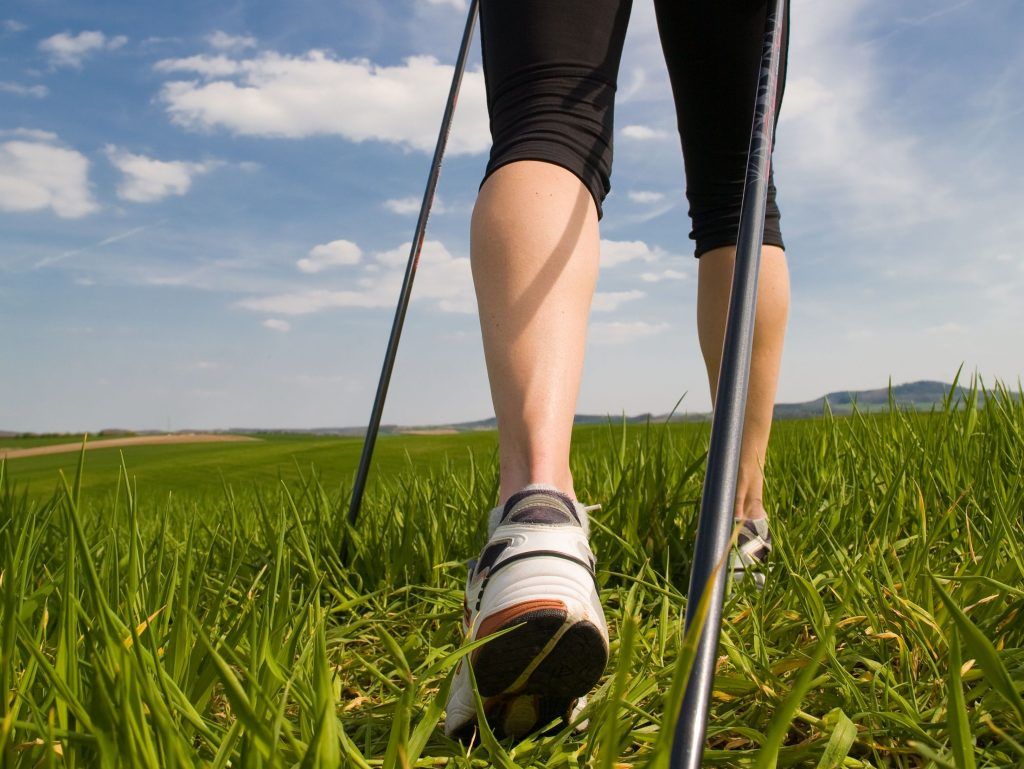
After the summer break the temptation is to pick up where you left off. Better not: here is how to pace your first weeks of Nordic Walking, check technique and kit, and reach autumn in good shape.
In September many people come back to Nordic Walking after a summer of breaks, travel and outings skipped because of the heat. It is the best time of year to do it: milder temperatures, days that are still long and routines starting up again. The most common mistake is just one: restarting from where you stopped at the beginning of summer, as if the weeks off did not count.
Here is how I recommend getting back into it: a month of gradual return, a check on technique and a check on kit. Nothing complicated, but it is the difference between a consistent autumn and a comeback that fizzles out after two weeks.
Why September is the right month to restart
The heat of July and August forces outings to dawn or dusk, and not everyone can manage that. September gives back the middle of the morning and the afternoon: you can walk when you have time, not only when the thermometer allows it.
There is also a simpler reason: it is the month when habits restart. An activity that finds its place in your week in September has a good chance of staying there, and Nordic Walking is practised all year round, winter included. Restarting well now means reaching the cold months with the movement already in place.
The first two weeks: slower than where you left off
After a few weeks off, your breathing comes back quickly, your technique less so. And the first part to notice is not the legs: it is the shoulders, back and forearms, which work on every push in Nordic Walking and usually rest during the summer. That is why the return needs pacing with the upper body in mind.
- Shorter outings. Two or three short sessions in the week are better than one long one on Sunday.
- Easy ground. Even, level surfaces with no climbs: at this stage you are working on the movement, not on effort.
- Conversational pace. If you cannot talk while you walk, you are going too hard for the first outings.
- A rest day between outings. It tells you how your shoulders and arms are reacting before you step things up.
A month of return, week by week
This is not a training plan: it is the progression I suggest to anyone coming back after summer without having walked regularly. If you kept going in August, shifting your times as explained in the article on Nordic Walking in the August heat, you can start straight from week three.
| Week | Length of outings | Terrain | What to focus on |
|---|---|---|---|
| 1 | Short | Level | Posture and long stride |
| 2 | Short to medium | Level | Pushing past the hip and opening the hand |
| 3 | Medium | Some ups and downs | A steady rhythm for the whole outing |
| 4 | As before the summer | Your usual routes | Holding the technique even when tiredness sets in |
If at the end of the month you still feel some way off your June level, there is nothing unusual about it: stretch week two or three rather than skipping ahead. Consistency matters more than how quickly you recover.
Checking your technique: the three points that slip first
After a break the movement does not disappear, but it gets shorter. It is always the same three details that slip away, and they are also the ones that make the difference between Nordic Walking and walking with two sticks in your hands.
The push that stops at your side
Your hand should travel past your hip. After a break it tends to stop beside your thigh, and the push is halved without you noticing.
The fist that stays closed
The first sign is sore forearms after a few outings. At the end of the push the hand should open and let the pole hang from the strap, then close softly again as the arm swings forward.
The pole that goes back to vertical
With tiredness the tip tends to slide forward, towards the foot. It should touch the ground behind the line of the opposite foot, at a clear angle: if it is vertical it brakes instead of pushing.
If you want a complete reference to check yourself point by point, the summary is in the guide to Nordic Walking technique in 5 points.
Checking your kit before the first outing
- Rubber paws and tips. If the paws are worn on one side or the metal tip is rounded, replace them: a contact point that slips ruins the push.
- Straps. Check that the clip works and the strap is not frayed: it is the part that lets you open your hand at the end of the push.
- Telescopic poles. Make sure the locks hold and the length is right. After a summer in the cellar they are often found set wrongly.
- Shoes. A sole worn at the heel makes your footing less stable in the long stride.
When, after three or four outings, your forearms keep aching or the push stays short, there is usually a habit to correct that you cannot see yourself: the back phase of the arm happens behind you. That is what the single Nordic Walking technique correction lesson is for: ninety minutes to put the movement right before autumn.
Three mistakes to avoid when you restart
- Making up for lost time. Cramming the outings you skipped in August into one week is the fastest way to have to stop again.
- Going straight for the hills. Uphill, push errors show less because the body compensates with the legs. The movement is fixed on the flat.
- Ignoring shoulders and forearms. Soreness that does not pass after a rest day is a sign to slow down, not to push on.
An important note: if you have a known heart, joint or respiratory condition, or if a health problem stopped you over the summer, talk to your doctor before starting again. I teach technique; I do not give clinical advice.
Frequently asked questions
How long does it take to get back in shape after the summer break?
It depends on how long the break was and how fit you were before. As a guide, a month of regular, progressive outings is usually enough to return to your early-summer level; if you need longer, stretch the middle weeks rather than forcing it.
Is it better to go out every day to catch up quickly?
No. In the first weeks the rest day between outings is for your shoulders and forearms, which tire before your legs after a break. Two or three outings a week is an excellent starting point.
Do I need new poles after the summer?
Hardly ever. Usually it is enough to replace worn paws or tips and check the straps and locks. Rechecking the length is only worth it if you have telescopic poles.
Can you do Nordic Walking in autumn and winter too?
Yes, it is practised all year round. With cooler weather what mainly changes is clothing, which should be layered, and how you handle breaks, which are best kept short.
If you would like to get back to walking in company, with someone watching your movement, we can set up a Nordic Walking outing tailored to you or to your group.