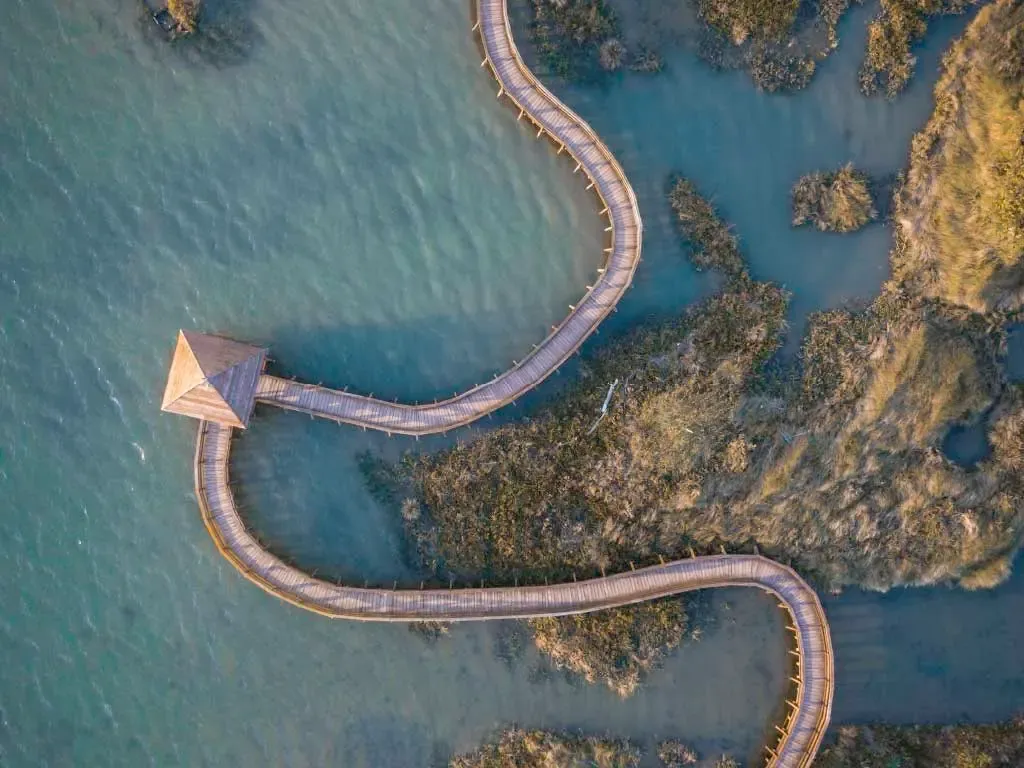
Five places to start from, the calendar of species season by season and the kit you actually need to watch birds in the Po Delta.
To start birdwatching in the Po Delta you need three things: 8×42 binoculars, the first two hours after sunrise and one of these five places — Sacca degli Scardovari, the Ca' Mello wetland reserve, the Porto Caleri Botanical Garden, the Ca' Pisani floodplain, Po di Maistra. The greater flamingo, the species most people come here for, is now present all year round.
The Delta is one of the best places in Europe to watch birds, and at the same time one of the easiest to get wrong: it is large, it is flat, and without knowing where to stop you end up driving for two hours along identical embankments without seeing much. This piece is here to avoid that.
Why the Delta works so well
It is a mosaic of very different habitats compressed into a few kilometres: brackish lagoons, fishing valleys, reedbeds, freshwater floodplains, salt marsh, coastal dunes and pine woods. Each habitat has its own species, and the distance between one and the next is often ten minutes by car.
The area is protected by the Veneto Regional Park of the Po Delta and is recognised as a UNESCO MAB Biosphere Reserve. More than three hundred bird species have been recorded: one of the highest concentrations in the country, and in winter the Delta is one of Italy's main wintering areas for waterbirds.
Five places to start from
1. Sacca degli Scardovari
The great lagoon of Porto Tolle, well known for shellfish farming. The shallow water and the mudflats exposed at low tide are the most reliable spot for flamingos, often in large groups, along with little egrets, grey herons, curlews and passing waders. It is easily watched from the embankment roads that ring it, staying in the car.
2. Ca' Mello wetland reserve
A restored freshwater wetland at Porto Tolle, with footpaths, hides and reedbed. This is the place I recommend to beginners: the distances are short, the hides are already there and the species are relatively confiding. Purple heron, little bittern, marsh harrier, reed warblers, kingfisher.
3. Porto Caleri Coastal Botanical Garden
At Rosolina Mare, on the dune ridge: white dunes, pine wood and back-dune within a few hundred metres, with laid-out trails. A different environment from the rest of the Delta, and therefore different species — scrub passerines, migrants resting along the coast, and in the wetlands behind, herons and ducks. Opening hours are seasonal: worth checking beforehand.
4. Ca' Pisani floodplain
In the municipality of Porto Viro, a sheet of fresh water ringed by reedbed and wet woodland. Excellent in winter for ducks and coots, and in spring for breeding herons. Less visited than the others, which helps.
5. Po di Maistra
The most intact and least engineered branch of the Delta, with riparian woodland, reedbeds and salt marsh. This is the place for anyone who already has an eye in and wants to look for less obvious species. It is best explored by bicycle along the embankments, or by boat with someone who knows the channels.
The calendar: what you see and when
| Period | What to expect |
|---|---|
| March – May | Spring passage, the richest moment: black-winged stilt, avocet, terns, glossy ibis, spoonbill, waders in breeding plumage. |
| June – July | Breeding. Fewer species but interesting behaviour: tern and little tern colonies, herons carrying food to the nest. Plenty of mosquitoes. |
| August – October | Autumn passage, long and drawn out. Waders on migration over the mudflats, concentrations on the muddy edges. Excellent light. |
| November – February | Wintering: large numbers of ducks, geese, coots and cormorants; marsh harrier and hen harrier over the reedbeds. Cold and windy, but the spectacle is guaranteed. |
The greater flamingo deserves a note of its own: from newcomer it has become a fixture of the Delta, observable in every season, with the highest numbers between late autumn and spring.
The kit you actually need
- 8×42 or 10×42 binoculars. The 8× is steadier in the hand and brighter at dawn: the better choice to start with.
- A telescope with tripod (20–60×), if you want to identify waders and ducks at distance. Distances in the Delta are long: here a scope is not a luxury, it is the difference between "a group of ducks" and a species list.
- A field guide in pocket format, or a good identification app.
- Neutral, windproof clothing. There is no shelter on the embankment.
- Rubber boots in spring and autumn.
- Mosquito repellent from May to September. This is not a detail.
Birds are far more tolerant of a stationary car than of a person on foot. Along the embankments, pull over, switch off the engine and wait five minutes: what settles around you after the silence is almost always more than you would see walking.
The unwritten rules
Birdwatching has a simple, non-negotiable ethic: the observation must cost the observed animal nothing.
- Do not approach nests or colonies during the breeding season, for any photograph.
- Do not use sound lures to draw birds out of the reeds.
- Stay on the paths and the embankments: salt marsh and reedbeds are fragile habitats.
- Close gates and respect property: much of the fishing valleys is private land.
- Keep dogs on a lead, or better still leave them at home.
One piece of advice on method
The tide matters more than the clock. At high water waders concentrate at a few roosts and are easy to find; at low water they scatter across the mudflats to feed and are a very long way off. Checking the tide tables before you go out is worth more than any extra piece of kit.
Frequently asked questions
Where can you see flamingos in the Po Delta?
The Sacca degli Scardovari is the most reliable spot, along with the lagoons and fishing valleys of Porto Tolle and Rosolina. They are easily watched from the embankment roads, staying in the car. They are now present all year round, with higher numbers between late autumn and spring.
What is the best time of year for birdwatching in the Po Delta?
Spring, between March and May, is the richest moment for variety, thanks to migration and breeding plumage. Winter, on the other hand, brings the biggest numbers, with remarkable concentrations of ducks and coots. Summer is the least varied season and the worst for mosquitoes.
Do you need a guide to go birdwatching in the Delta?
No, many areas are freely accessible with paths and hides. A guide is mainly useful for two things: knowing where to stop across a very large area, and identifying the difficult species, of which the Delta has plenty.
What binoculars do you need to start?
An 8×42 is the best compromise: enough magnification to identify, enough stability in the hand, good brightness at dawn and dusk. A telescope comes later, when the distances of the Delta start to feel restrictive.
Can you tour the Delta by bicycle?
Yes, and it is one of the best ways: the embankments are flat and rideable for tens of kilometres, and a bicycle is silent. Allow for exposure to the wind, which here is constant and at times demanding.
I run nature-watching outings in the Delta, in small groups and with timings built around the light and the tide. You will find the options among the tours; if you are after something different, write to me. And if the other half of my territory interests you, here is the guide to hiking in Val di Funes.